
Industrial Consultants
Self Contained Breathing Apparatus Training
When delivered on-site, SCBA training is a highly effective way to help you and your team feel more comfortable when donning personal protective equipment (PPE) in real life scenarios. You will experience hands-on activities and exercises with the equipment that you will use in an emergency response situation.
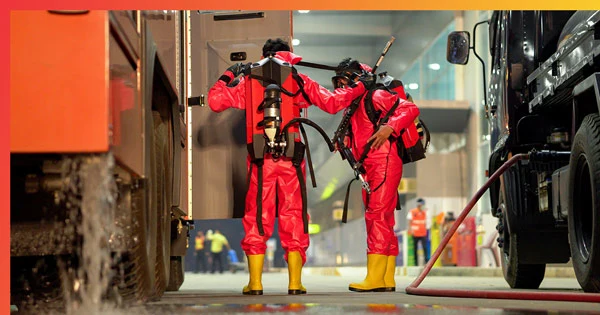
SCBA Training Customized To Your Facility
Our responsibility is to properly train you and equip you with the information you need to protect yourself and get you home to your families each day. Our trainers love spending time onsite with you to demonstrate proper use of your PPE, ensuring you are comfortable with what you are using and providing you with peace of mind as you go to work each day. Our team is standing by to help with your SCBA training needs.
Course: Self-Contained
Breathing Apparatus (SCBA) Training
Requirement
OSHA 1910.134
Duration
4 Hours
Description
Industrial Consultants’ SCBA Training course is designed to provide employees with the knowledge and hands-on practice needed to properly inspect, don, use, remove, clean, store, and maintain self-contained breathing apparatus used during emergency response activities.
This course is intended for facilities that maintain emergency response teams or use hazardous chemicals onsite that may require employees to wear an SCBA
Participants will review respiratory hazards, exposure terms and limits, the respiratory system, general OSHA health hazards, and the basic requirements of a written respiratory protection program. The course also covers when an SCBA should be used, approved respirators for IDLH atmospheres, breathing air requirements, SCBA components, cylinder use, facepiece seal checks, warning devices, air management, communication while wearing an SCBA, and basic emergency response considerations.
Training includes practical, hands-on instruction using the type of equipment employees may be expected to use at their facility. Participants will practice inspecting an SCBA, donning the unit, performing required checks, operating while wearing the SCBA, completing basic SCBA exercises, doffing the unit, cleaning and disinfecting the equipment, and properly returning it to storage.
This course also includes SCBA inspection and maintenance requirements. Participants will review pre-use inspections, monthly inspection expectations for emergency-use respirators, cylinder pressure verification, regulator and warning-device function checks, inspection documentation, cleaning, disinfecting, storage, repairs, and criteria for removing equipment from service.
OSHA respiratory protection standards, employers must provide initial training and annual retraining/certification for anyone designated to wear an SCBA
Scope
This course covers:
- History of Respirators/SCBA’s
- Overview of OSHA 1910.134
- Review of Respiratory Hazards
- Approved Respirators for IDLH atmospheres
- Hands on training
- Inspection and Maintenance of SCBA’s
Who Should Attend
Employees, firefighters, and emergency response team members who must wear an SCBA during professional duties, hazardous atmosphere operations, rescue work, or confined space entry. Trainees typically must pass a medical evaluation and fit test before using the equipment.
Related Services
 IC Brochure
- 4 Hour First Responder Awareness Level
- 8 Hour First Responder Awareness Level
- 8 Hour First Responder Operations Level
- HAZWOPER 24 Hour
- 40 Hour HAZWOPER
- 8 Hour Emergency Responder Refresher
- 8 Hour Incident Commander
- HAZMAT Documentation Kit
SCBA FAQs for Facility's with Hazardous Chemicals
01 What is SCBA Training?
Our SCBA training reviews Personal Protective Equipment, how to properly don it, and proper use of it. It is four hours in length, and is a hands-on course using the equipment you will need in an emergency response situation at your facility.This course is important for companies that have an emergency response team, or for companies that house chemicals on site that could create a hazardous situation. It teaches employees what to wear when working around each chemical, the hazards of chemical reactivity and health hazards, to name a few.
02 What does SCBA stand for?
SCBA is defined as Self-Contained Breathing Apparatus.
03 When should SCBAs be replaced?
SCBA’s are comprised of three main components. The air tanks, the back pack assembly and the regulator. Steel and Aluminum tanks should be hydrostatically tested every five years, composite bottles (which are made up of two or more materials) are 3 years and have a fifteen-year life span. After the fifteen years have passed as of now, they need to be replaced by something newer.
The back pack assembly will need to be inspected monthly as to the straps and fasteners are still working and in good shape.
The regulator will need to be checked for proper operation each month and once a year the regulator must be flow tested to verify it is still supplying atmospheric pressure plus one pound to verify it is operating as a positive pressure regulator.
OSHA does have a great checklist to go buy when one must check the equipment every month. The bottles may also have to be replaced if they do not pass the hydrostat date.
04 What are the two types of SCBA?
There are two primary types of SCBA’s: open circuit and a closed circuit. What this means is that the open circuit is a supplied airline or hose from a continuous source of outside air and the closed circuit means the wearer has the air bottle on their persons.
05 Is an SCBA considered a respirator?
Yes. An SCBA is a type of respirator. OSHA defines a self-contained breathing apparatus as an atmosphere-supplying respirator where the breathing air source is carried by the user. Unlike cartridge respirators, an SCBA does not filter the surrounding air. It supplies breathing air from the cylinder worn by the user.
06 What are common SCBA cylinder pressures?
SCBA cylinders are commonly available in different rated pressures, including 2,216 psi, 3,000 psi, and 4,500 psi. These are often associated with approximate rated service durations such as 30-minute, 45-minute, or 60-minute cylinders, depending on the manufacturer and cylinder size.
The duration is based on testing conditions and should not be treated as a guaranteed work time. During actual emergency response, the usable airtime may be much shorter depending on the user’s breathing rate, workload, stress level, physical condition, and how the equipment is used.
07 When does the SCBA low-air alarm activate?
SCBAs are equipped with a low-air warning device that alerts the user when the air supply is getting low. Older SCBA units activated the low-air alarm at 25% of the cylinder remaining pressure. Newer NFPA-compliant emergency service SCBAs activate the low air alarm at 33% of the cylinder remaining pressure.
This change is associated with the 2007 edition of NFPA 1981, which increased the low-air alarm/end-of-service-time indicator requirement from 25% to 33%. For training purposes, employees should always verify the specific alarm point for the SCBA model used at their facility and follow the manufacturer’s instructions and facility procedures.
When the low-air alarm activates, the user should not continue working. The alarm means it is time to exit the response area immediately.
08 How often do emergency-use SCBAs need to be inspected?
SCBAs maintained for emergency use must be inspected before use, after use, and at least monthly. Inspections should verify cylinder pressure, facepiece condition, straps, regulator function, hoses, warning devices, overall condition, and readiness for use. Inspections must be documented.
09 Can any employee put on an SCBA or air purifying respirator and investigate an ammonia leak?
No. Employees should not investigate or enter areas with a suspected ammonia release unless they are specifically trained and authorized to do so.
Employees who are expected to investigate or respond to an ammonia release must be trained on the facility’s incident investigation procedures, ammonia hazards, and the proper selection and use of respiratory protection. They must also be medically cleared, fit tested, and trained on the specific respirator they may be required to use.
10 Can employees use an SCBA without being fit tested?
No. Employees using a tight-fitting SCBA facepiece must be medically cleared, fit tested, and trained before use. A proper facepiece seal is critical because leaks can allow ammonia or other hazardous contaminants into the facepiece.
11 When should an APR be upgraded to an SCBA around ammonia?
For ammonia response, 300 ppm should be treated as the maximum concentration where responders transition to an SCBA, because NIOSH identifies ammonia’s IDLH concentration as 300 ppm.
An APR may be appropriate below that level, but only when the ammonia concentration has been measured or reasonably evaluated.
Some states, facilities, or company programs require the transition from APR to SCBA at a lower concentration, such as 250 ppm. This is usually tied to respirator selection requirements and maximum use concentration calculations. For example, if a program uses a 25 ppm exposure limit and the employee is wearing a APR with an assigned protection factor of 10, the maximum use concentration would be:
25 ppm × 10 = 250 ppm
That is why California, Oregon, and some other states or company programs may require employees to move out of an APR and into a higher level of respiratory protection at or before 250 ppm. The exact requirement depends on the applicable state requirements, the facility’s written respiratory protection program, the respirator type, and assigned protection factor.